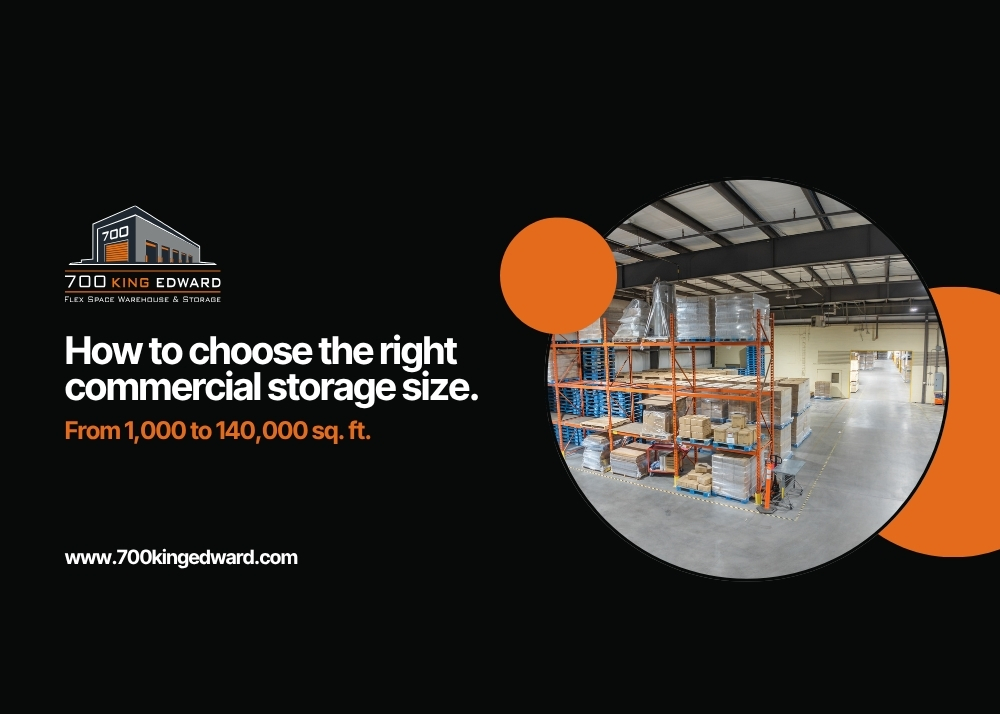
How to choose the right commercial storage size. From 1,000 to 140,000 sq. ft. our Winnipeg Warehouse can accommodate..
Choosing the right commercial storage size is an important decision for any business that needs additional warehouse space. Lease too much space, and you may end up paying for square footage you are not using. Lease too little, and your facility can quickly become overcrowded, making it harder to manage inventory, equipment and day-to-day operations.
The right amount of warehouse space depends on much more than how much inventory you have today. You also need to consider how your products are stored, how frequently inventory moves, how much room is needed for receiving and shipping, and whether your business is expected to grow.
At 700 King Edward Flex Space Warehouse & Storage in Winnipeg, businesses can lease warehouse space starting at approximately 1,000 square feet and expand into spaces up to 140,000 square feet. This range gives businesses the flexibility to find a storage solution that matches their current requirements while leaving room for future growth.
Why choosing the right storage size matters
Warehouse space is an operating expense, so the goal should not simply be to find the biggest facility available.
A warehouse that is too large can result in unnecessary overhead. You may be paying for space that sits unused, while also spending more on heating, lighting, maintenance and other facility-related costs.
A warehouse that is too small creates a different set of problems. Inventory can become difficult to organize, aisles may become crowded, receiving areas can become congested, and employees may spend more time looking for products or moving items around.
The right warehouse size should give your business enough room to operate efficiently without paying for substantially more capacity than you actually need.
What can you store in commercial warehouse space?
The type of inventory or equipment you need to store will have a major impact on how much space you require.
A business storing boxed retail products may be able to make efficient use of vertical shelving and pallet storage. A construction company may need additional floor space for equipment and materials. A manufacturer may need room for raw materials, finished products and equipment.
E-commerce businesses may need space for inventory, picking, packing and shipping. Importers and distributors may require larger areas for incoming shipments and ongoing product storage.
At 700 King Edward Flex Space and Storage, warehouse space is designed to accommodate a variety of business requirements, including manufacturing equipment, retail inventory, construction materials, wholesale products and e-commerce inventory.
Is 1,000 square feet enough for your business?
For some businesses, 1,000 square feet can provide enough additional capacity to solve an immediate storage problem without taking on a large warehouse.
This size may be appropriate for companies that need overflow storage, temporary inventory space, equipment storage or additional room while they transition between facilities.
It can also be a practical starting point for a growing business that does not yet know exactly how much warehouse space it will need in the future.
The important consideration is how efficiently the space can be organized. A well-planned 1,000-square-foot warehouse can sometimes be more useful than a significantly larger space that is poorly laid out.
When should you consider 5,000 to 10,000 square feet?
As inventory volumes increase, businesses may need enough space to separate different parts of their operation.
A company might need dedicated areas for receiving, storage, order preparation and outgoing shipments. Equipment or materials may also require additional floor space.
The 5,000 to 10,000 square foot range can be worth considering for businesses that have moved beyond basic overflow storage and need a more substantial warehouse footprint.
The right size within this range will depend on inventory volume, product dimensions, storage methods and how frequently goods move through the facility.
When does a business need 10,000 to 50,000 square feet?
Larger warehouse requirements are often associated with businesses managing significant inventory volumes or more complex operations.
Distributors, wholesalers, manufacturers, importers, exporters and larger contractors may need substantial space for inventory, equipment, receiving and shipping.
At this point, warehouse planning becomes increasingly important. Simply estimating the amount of floor space required for inventory is not enough. You also need to account for aisles, loading areas, employee movement, equipment and future inventory.
A business that expects inventory levels to increase should also consider whether the warehouse provides enough room to accommodate that growth without requiring another move.
When might 50,000 to 140,000 square feet make sense?
Businesses requiring tens of thousands of square feet are typically dealing with significantly larger inventory, distribution or operational requirements.
Large manufacturers, distributors, logistics operations, importers, exporters and companies with substantial inventory volumes may require this level of capacity.
At this scale, warehouse space becomes closely connected to the overall logistics strategy of the business. Receiving, storage, picking, staging and shipping all need to work together efficiently.
700 King Edward Flex Space and Storage can accommodate larger warehouse requirements up to approximately 140,000 square feet, giving businesses the option to scale beyond smaller storage areas without necessarily moving to another facility.
Don't calculate storage space based only on inventory
One of the most common mistakes businesses can make is looking only at how much inventory they need to store.
Your products need room around them.
You may need aisles for employees and forklifts, space for receiving incoming shipments, staging areas for outgoing orders and room to safely access inventory.
If products are stacked on pallets or shelving, the height of the facility also becomes important. Warehouse space should be considered in three dimensions, not just by square footage.
The way your inventory moves through the facility can also affect how much space you need. A business with frequent receiving and shipping activity may require more operational space than a business that stores products for long periods.
Think about your future growth
Your current storage requirements are only one part of the decision.
If your business is growing quickly, choosing a warehouse that barely accommodates today's inventory may mean having to move again sooner than expected.
On the other hand, leasing a dramatically larger facility based only on projected growth can create unnecessary costs.
The goal is to find a reasonable middle ground.
Flexible warehouse space can make this easier because businesses do not necessarily have to make a permanent decision based on today's requirements. At 700 King Edward Flex Space and Storage, businesses can start with smaller warehouse space and move into larger areas as their requirements change.
Consider how often inventory moves
The amount of inventory you store is not the only factor. How quickly that inventory moves through the warehouse matters as well.
A company receiving and shipping products every day may need more operational space for staging, loading and unloading. A business storing equipment or materials for longer periods may have different requirements.
If products are constantly moving through your warehouse, you need enough space to prevent receiving and shipping areas from interfering with stored inventory.
This is where warehouse layout becomes just as important as square footage.
Consider loading and unloading requirements
Your warehouse should also match the way goods arrive and leave your business.
If you regularly receive pallets, large shipments, equipment or freight trucks, you need appropriate loading access and enough space to manage those activities.
700 King Edward Flex Space and Storage has five loading docks and six grade-level doors, along with on-site forklift services and driver support for loading and unloading when required. Cross-docking services are also available for businesses that need goods to move through the facility without being stored for extended periods.
These services can be an important consideration when determining the practical value of a warehouse, not just its size.
Do you need office space too?
Some businesses need more than storage.
If administrative, sales, customer service or management employees need to work close to warehouse operations, combining office and warehouse space can make sense.
Keeping these functions under one roof can reduce the need for separate locations and make communication between office and warehouse teams easier.
700 King Edward Flex Space and Storage offers modern office space alongside its warehouse facilities, giving businesses the option to combine office and storage requirements in one location.
For a growing company, this can provide a more convenient setup without requiring a separate commercial office lease.
Consider short-term versus long-term needs
The amount of warehouse space you need today may not be the same amount you need next year.
A seasonal business may need additional storage for only a few months. A company entering a new market may need temporary capacity while it determines how much inventory it will eventually carry.
Other businesses may have a permanent need for warehouse space.
700 King Edward Flex Space and Storage offers flexible warehouse arrangements for both short-term and long-term requirements, with lease terms typically starting at 30 days and weekly arrangements available by request, subject to applicable terms and pricing.
This can allow businesses to choose a storage arrangement based on their actual requirements rather than automatically committing to a long-term facility.
Think about the total cost, not just the square footage
A lower price per square foot does not necessarily mean a lower overall cost.
A warehouse that is cheaper but difficult for trucks to access could increase transportation expenses. A facility without suitable loading access may require additional handling. A location far from your employees, suppliers or customers could also add travel time.
Services and infrastructure matter too.
Climate control, security, loading docks, forklift services, office space and accessibility can all affect the overall value of a warehouse.
700 King Edward Flex Space and Storage provides climate-controlled warehouse space, security patrols, camera coverage, loading docks, grade-level doors, forklift services and optional office space.
How to determine the right commercial storage size
There is no single warehouse size that works for every business.
Start by looking at your current inventory and equipment requirements. Then consider how much space you need for aisles, receiving, shipping, staging and employee movement.
Next, look at your expected growth. If you anticipate significantly higher inventory volumes over the next year or two, consider whether your chosen space can accommodate that growth.
Finally, look at the facility itself. Location, loading access, security, climate control, forklift availability and lease flexibility can all influence whether a warehouse is a good fit.
The goal is to choose a space that supports the way your business actually operates, rather than simply choosing a number of square feet.
Find commercial storage space in Winnipeg
Whether you need approximately 1,000 square feet for additional inventory or a much larger warehouse for distribution and ongoing operations, choosing the right amount of space can help your business control costs and operate more efficiently.
700 King Edward Flex Space and Storage offers commercial warehouse space in Winnipeg ranging from approximately 1,000 square feet to 140,000 square feet. The facility provides flexible warehouse arrangements, climate-controlled storage, loading docks, grade-level doors, forklift services, cross-docking, security and optional office space.
Request a quote or schedule a tour for commercial storage space
Not sure how much warehouse space your business actually needs?
700 King Edward Flex Space and Storage can help you discuss your storage requirements and determine what type of space may be appropriate for your operation.
Request a quote or schedule a tour today!

Contact Us
700 King Edward Street
Winnipeg, Manitoba, Canada, R3E 0R9
x 204-775-7799
A info@700KingEdward.com
